Stage Management
Overview
Stage Management helps you organize participants into different parts of your study. It’s useful for studies that have multiple sections or happen over time. Using stages makes it easier to track, filter, and analyze participants based on when they took part in the study, either as a pilot participant or during different phases of data collection.
Getting Started
Sign in as an administrator, open Analysis, and select the Stage Management tab.
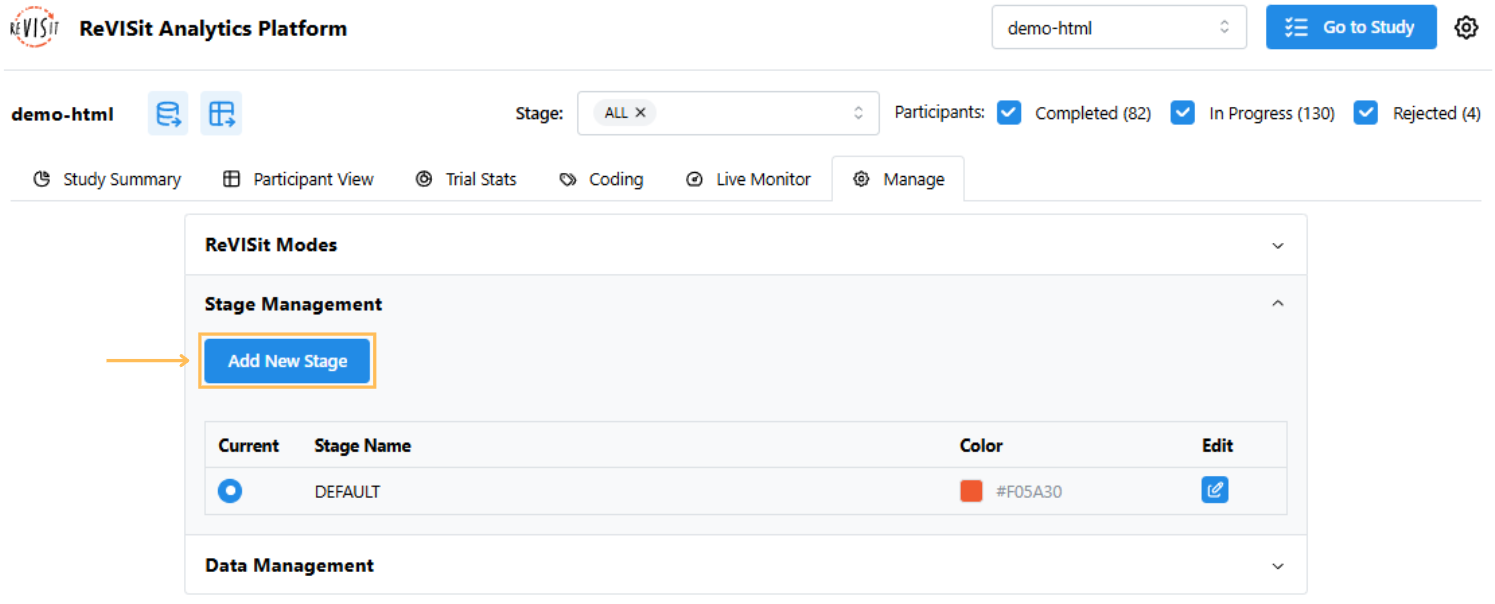
All studies start with a DEFAULT stage, which cannot be removed. The default color is orange (#F05A30), but you can change it if you want.
Adding a New Stage
- Click the Add New Stage button.
- Enter a stage name and pick a color. You can type a color code or choose one from the color picker.
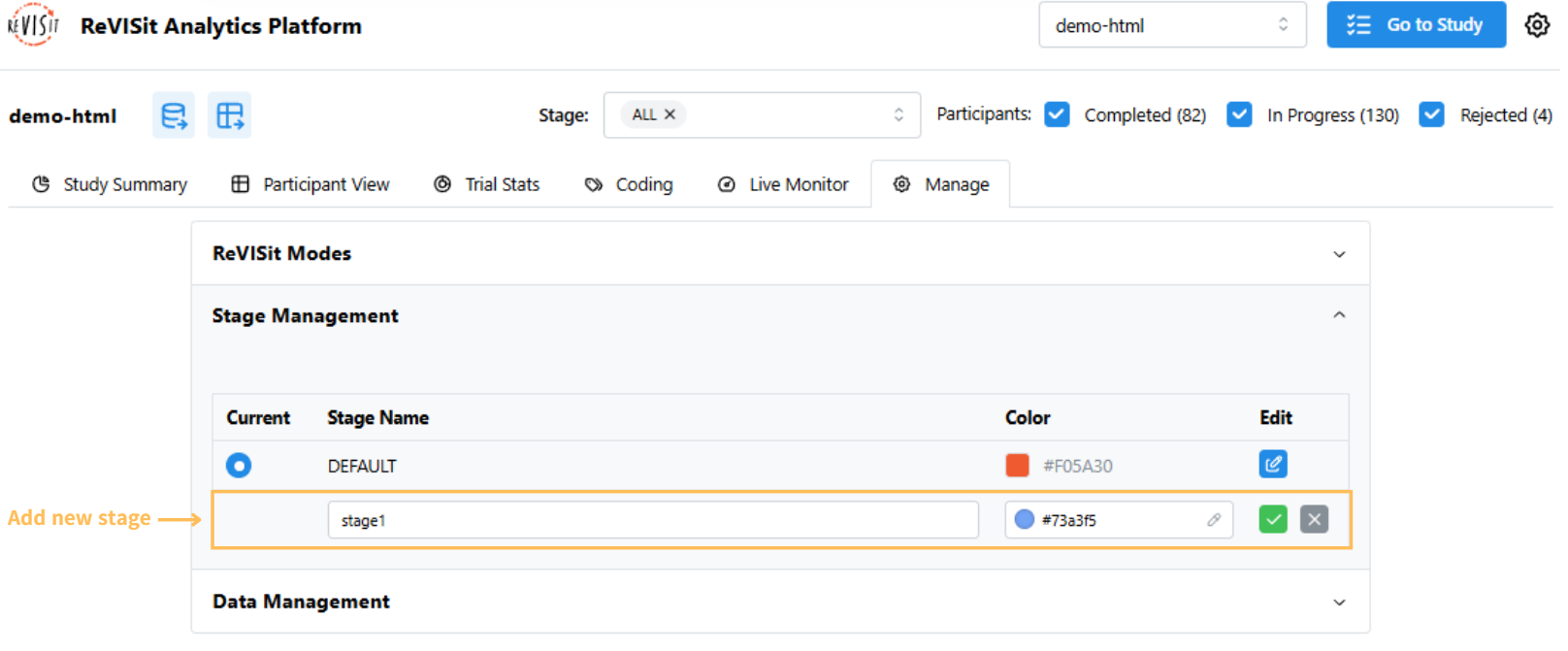
- Click the green check mark to save.
Stage names cannot be DEFAULT, ALL, or N/A.
Setting the Current Stage
The active stage determines where new participants will be added. Click Inactive next to the stage you want, then confirm with Yes, activate stage. Its status changes to Active. Existing participants stay in their original stages.
Monitoring Participants and Conditions
The stage table shows Current (ongoing participants), Completed, and Total / Maximum. The total includes both ongoing and completed participants. Rejected participants are excluded from these counts.
The Participant limits for panel applies to the active stage. If your Study Config declares between-subject factors, the panel also shows a row for each combination of factor levels, with its own Current, Completed, Total / Maximum, and Enabled controls. Counts and recruitment settings apply separately to each stage; participants from earlier stages do not count toward the active stage's limits.
Controlling Recruitment
Use the Enabled switch for a condition combination to control whether new participants can receive it. Confirm the change in the Enable condition? or Disable condition? dialog. Disabling a combination stops future assignments to it without changing existing participants or their data. You can enable it again later.
Once a stage has participant assignments, you can add conditions but cannot remove or rename its existing conditions. Disable recruitment to an existing condition, or create a new stage when you need a different set of conditions.
Setting Participant Limits
Turn on Limit participants to set a maximum for the active stage. Enter Maximum participants, then leave the field to save it. Without a limit, the stage table shows Unlimited.
For studies with between-subject factors, Assign participants lets you choose how to divide that maximum:
- Evenly divides the maximum across enabled condition combinations. If it cannot be divided equally, some combinations receive one extra place. For example, a maximum of 10 across three enabled combinations gives targets of 4, 3, and 3.
- Manually lets you edit each condition's maximum in Total / Maximum. Leave each field to save it. The stage's Maximum participants follows the sum of the condition maximums, so edit the condition fields to change that total.
Both ongoing and completed participants use places. New assignments stop when the stage maximum or the eligible conditions' targets are reached. Disabling a condition in manual mode preserves its target; it does not automatically give those places to another condition.
You cannot save a new stage maximum or manual condition target below the number of participants already assigned, excluding rejected participants. Setting it equal to the current total is allowed and leaves no places for new participants at that limit. For example, a condition with 6 completed and 2 ongoing participants needs a manual target of at least 8.
Timing Out Ongoing Participants
To review participants who have not finished, click a nonzero Current count in the stage table or a condition row. The In-Progress Participants dialog lists participants for that stage or condition, with their participant number, ID, and elapsed time. If the assignment's start time is unavailable, it shows Length unavailable.
Click Time Out beside a participant to reject them with the reason Timed out by admin. Their collected data is retained, their sequence assignment becomes available for reuse, and they no longer count toward stage or condition capacity. This frees a place for a replacement when the recruitment settings allow one.
Time Out is a manual action; elapsed time alone does not expire a session. A participant who is still working discovers the rejection on their next save. Review the participant before freeing their place.
When Admission Is Closed
New participants see a Study full page when they cannot be admitted. If the stage maximum has been reached, the message is “Sorry, no more participants can join the [stage name] stage at this time.” If all conditions are disabled, or only disabled conditions have capacity, the message is “Sorry, this study is full and cannot accept more participants at this time.”
To reopen recruitment, activate a stage with available places, increase the relevant limits, enable a condition with capacity, or time out an abandoned ongoing participant.
Changing Stage Colors
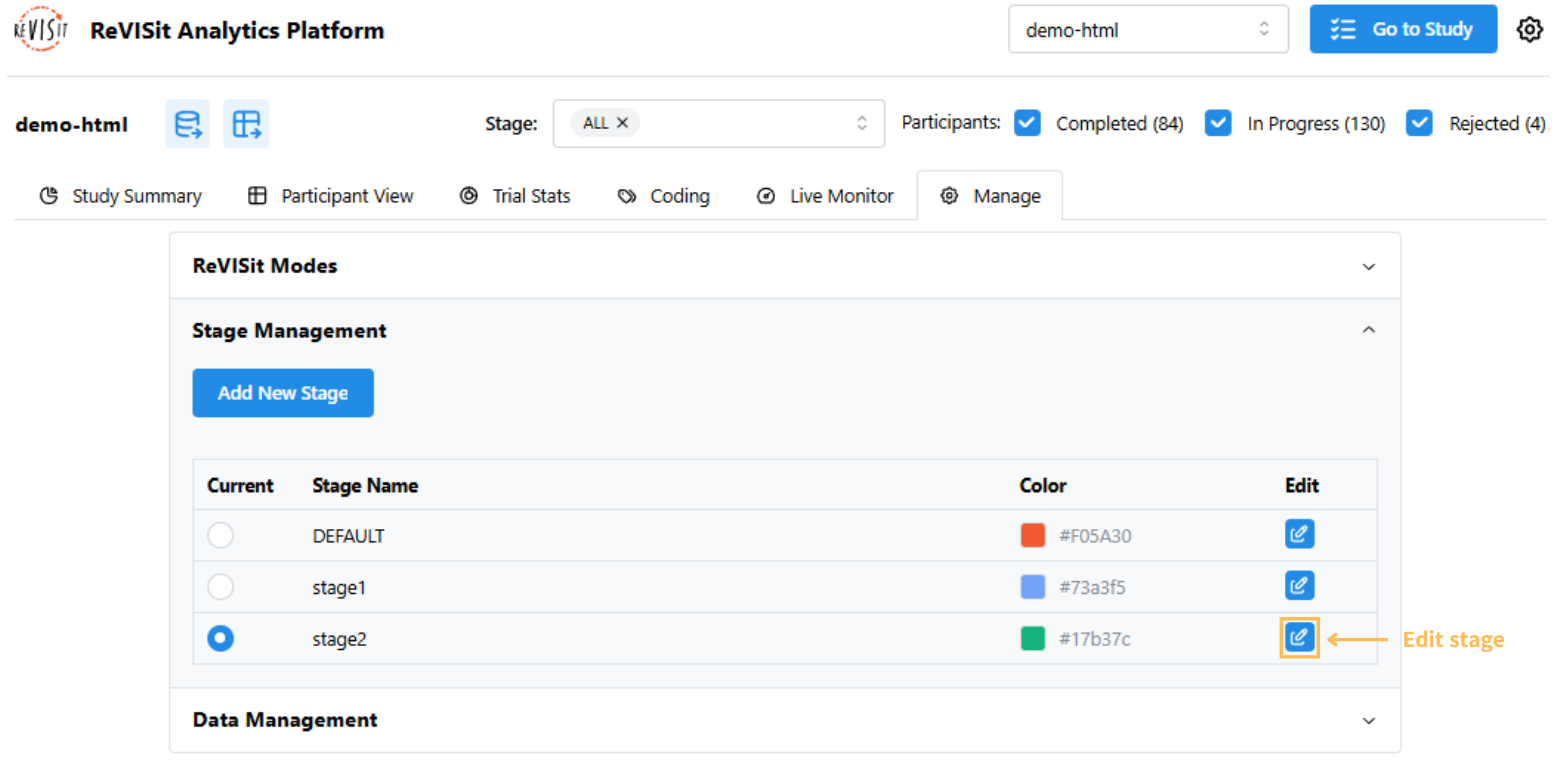
Each stage has a color to help you identify it in the analysis views. To change a stage color:
- Click the edit icon.
-
Pick a new color or enter a color code.
-
Click the green check mark to save.
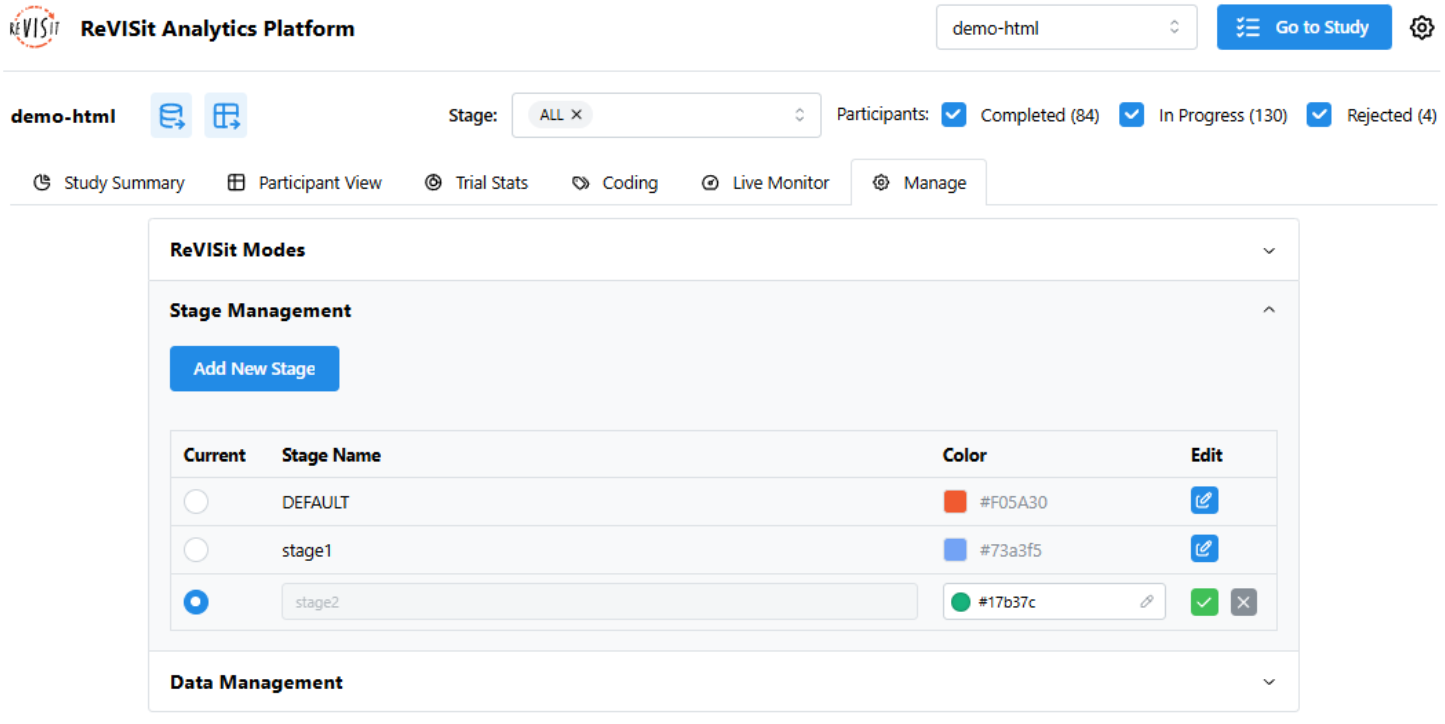
Stage names cannot be changed after you create them, but you can always change the color.
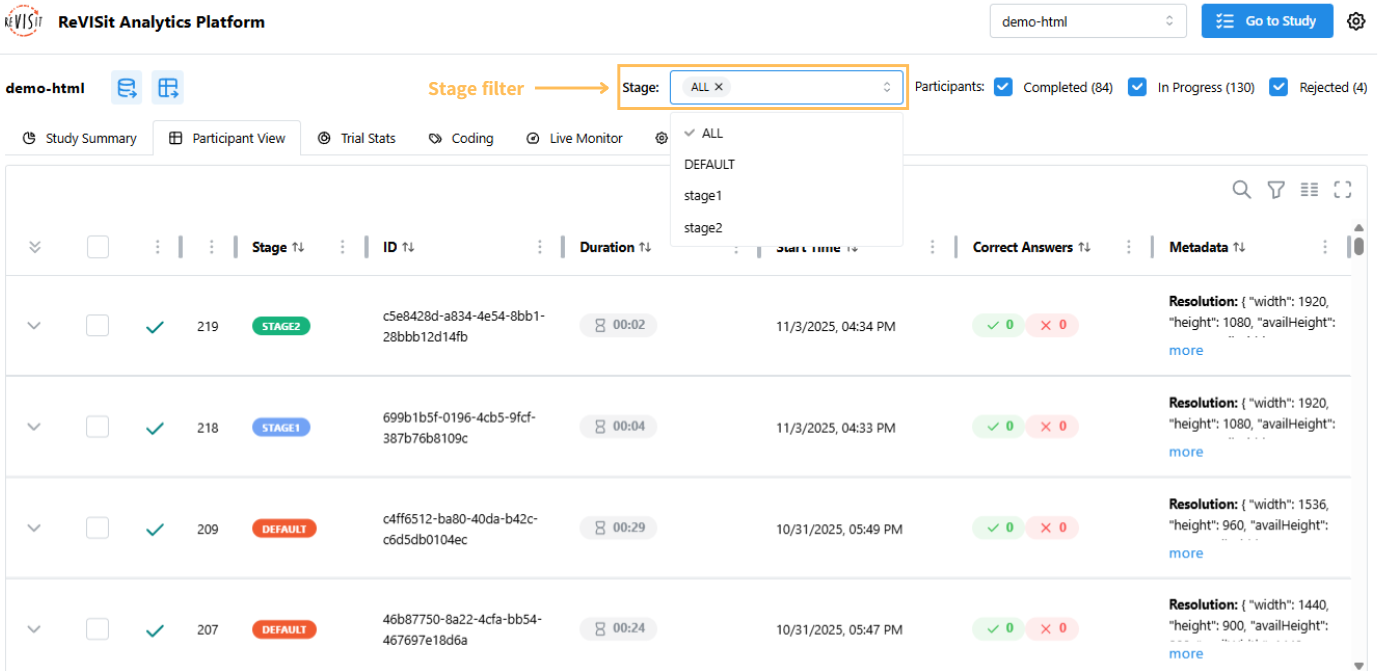
Stage Filter in Participant View
Each participant’s stage is shown in the table, making it easy to see and group participants. You can filter by stage using the filter at the top and select one or more stages.