Device Restrictions
ReVISit lets you control whether participants can enter a study based on screen size, browser version, device type, and input method.
These checks are configured in studyRules.
Configuring Study Rules
studyRules supports:
display: allowed display sizesbrowsers: allowed browser names and optional minimum versionsdevices: allowed device types (desktop,tablet,mobile)inputs: allowed input types (mouse,touch)
minWidth and minHeight are now configured under studyRules.display instead of uiConfig.
The previous properties minWidthSize and minHeightSize have been renamed to minWidth and minHeight. The minWidthSize and minHeightSize property is now removed and should no longer be used.
The following snippet shows how to configure device restrictions:
"studyRules": {
  "display": {
    "minHeight": 400,
    "minWidth": 800
  },
  "browsers": {
    "allowed": [
      {
        "name": "chrome",
        "minVersion": 100
      },
      {
        "name": "firefox",
        "minVersion": 100
      },
      {
        "name": "safari",
        "minVersion": 10
      }
    ],
    "blockedMessage": "You must be on a relatively modern browser, Chrome > 100, Firefox > 100, Safari > 10."
  },
  "devices": {
    "allowed": ["tablet", "desktop", "mobile"]
  },
  "inputs": {
    "allowed": ["touch", "mouse"]
  }
}
How It Works
When a participant starts the study, reVISit validates the participant environment against studyRules.
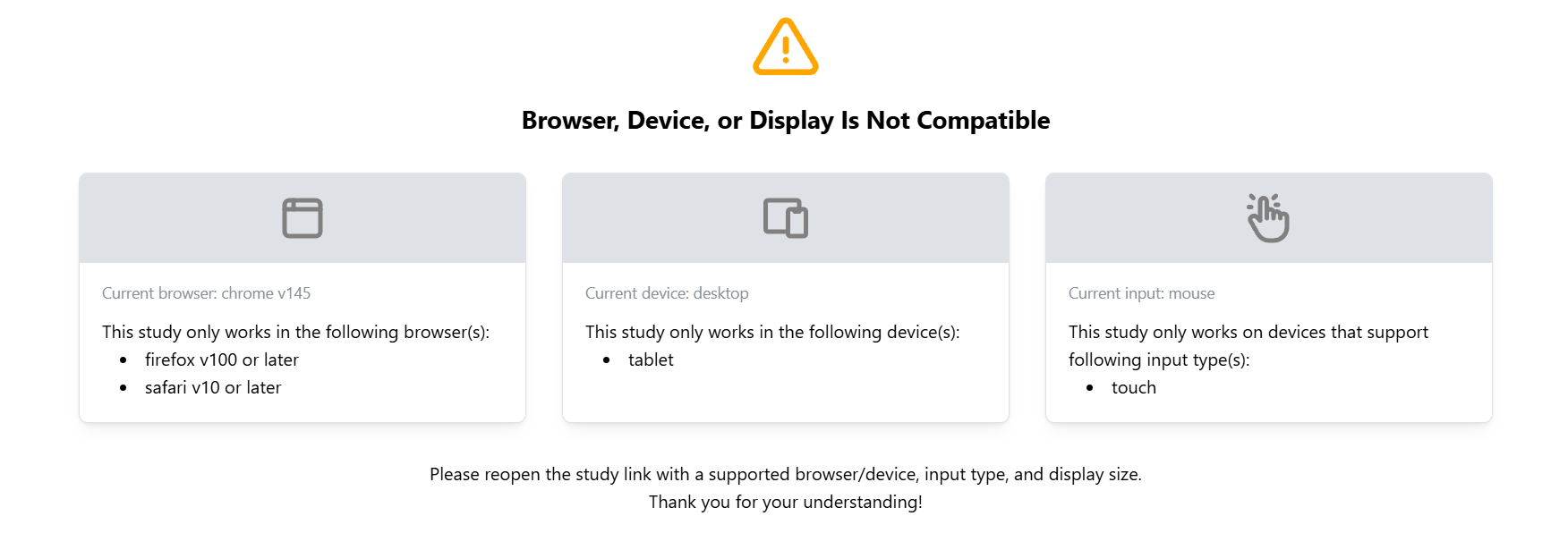
If requirements are not met, a blocking screen is shown with the rule that failed.
Setting Display Requirements
You can restrict your study to specific screen-size requirements to ensure participants use a supported display.
Configure display restrictions in the studyRules section. Use studyRules.display to define minimum and optional maximum screen dimensions.
"studyRules": {
  "display": {
    "minHeight": 600,
    "minWidth": 1024,
    "maxHeight": 1440,
    "maxWidth": 2560,
    "blockedMessage": "This study requires a screen between 1024x600 and 2560x1440."
  }
}
For display-size checks, participants see a warning screen with a one-minute countdown timer showing current and required dimensions.
The participant has one minute to resize their browser window. During this time, reVISit continuously monitors the window size. Once both the width and height meet the requirements, the warning disappears and the study begins.
If the timer runs out and the screen is still too small, the participant will see a training failed page and will not be able to continue the study.
In the participant table, the participant will be listed as rejected with the reason "Screen resolution requirements not met."

Setting Browser Requirements
You can restrict your study to specific browsers and their minimum versions to ensure compatibility with your study design.
Configure browser restrictions in the studyRules section:
"studyRules": {
  "browsers": {
    "allowed": [
      {
        "name": "chrome",
        "minVersion": 100
      },
      {
        "name": "firefox",
        "minVersion": 100
      },
      {
        "name": "safari",
        "minVersion": 15
      }
    ],
    "blockedMessage": "This study requires Chrome, Firefox, or Safari with the minimum versions specified."
  }
}
You can specify browser restrictions for:
chromefirefoxsafariedge
Each browser can have an optional minVersion to ensure participants have a recent version with necessary features.
Setting Device Type Requirements
You can control which device types (desktop, tablet, mobile) can access your study based on your research needs.
Configure device type restrictions in the studyRules section:
"studyRules": {
  "devices": {
    "allowed": ["desktop", "tablet", "mobile"],
    "blockedMessage": "This study requires a desktop or tablet device."
  }
}
The allowed array specifies which device types can participate. You can include any combination of:
desktoptabletmobile
Setting Input Requirements
You can specify which input methods your study supports, such as mouse and/or touch input.
Configure input restrictions in the studyRules section:
"studyRules": {
  "inputs": {
    "allowed": ["mouse", "touch"],
    "blockedMessage": "This study requires a device with mouse or touch input capability."
  }
}
The allowed array specifies which input methods are supported:
mouse- Mouse or trackpad inputtouch- Touch input (touchscreen or touch-enabled device)
Example
Here's a complete example combining all restriction types:
"studyRules": {
  "display": {
    "minHeight": 400,
    "minWidth": 800
  },
  "browsers": {
    "allowed": [
      {
        "name": "chrome",
        "minVersion": 100
      },
      {
        "name": "firefox",
        "minVersion": 100
      },
      {
        "name": "safari",
        "minVersion": 10
      }
    ],
  },
  "devices": {
    "allowed": ["tablet", "desktop", "mobile"]
  },
  "inputs": {
    "allowed": ["touch"],
    "blockedMessage": "Only touch devices are supported"
  }
},